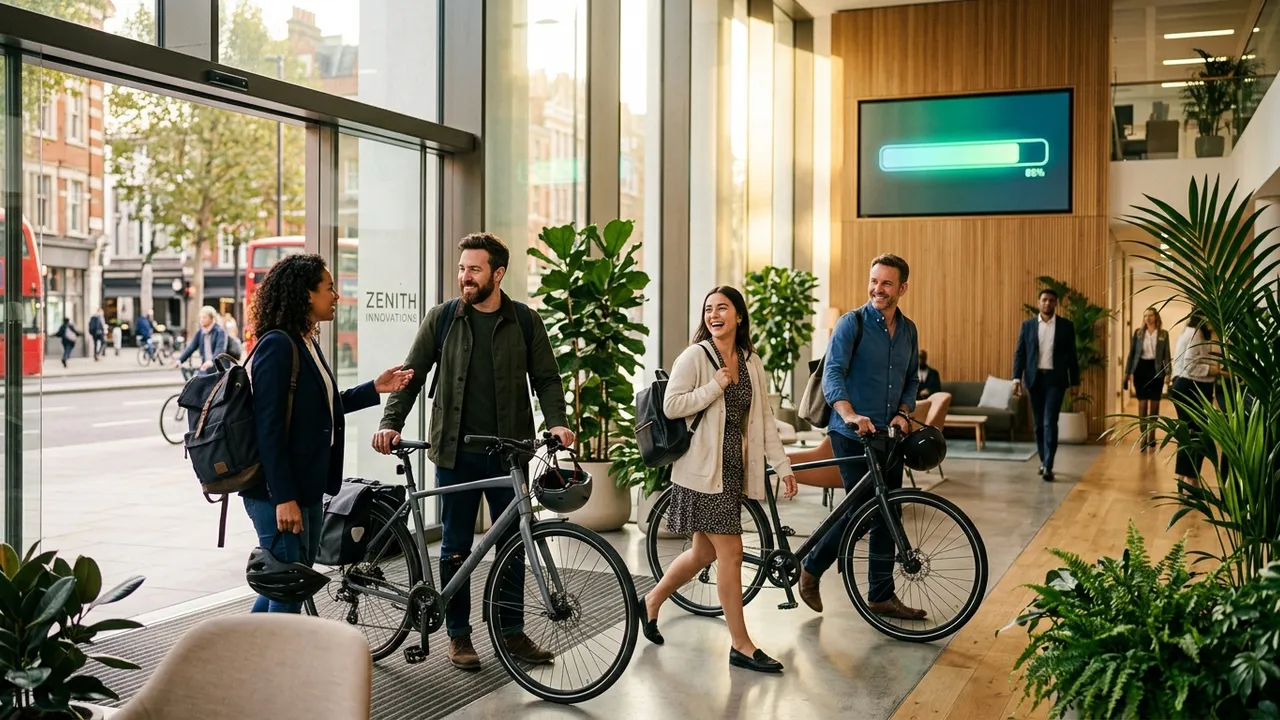
Kilometre week: a week in which every journey counts
Movement offerings rarely fail because of willingness and almost always because of the calendar. The kilometre week therefore asks for no extra appointment: it counts the journeys people make anyway — and turns them into one shared number.
Why kilometres are a more honest unit than appointments A course offering measures sign-ups. A kilometre week measures distance — and distance also accumulates among people who would never come to a course: on the commute, during the lunch break, on the walk to the neighbouring building. Someone who gets off two stops early contributes just as much as the colleague who cycles in. That is precisely the difference between an offering for the sporty few and a measure the whole team can join — the point at which most of the impact is otherwise lost in BGM.
Three ways to collect kilometres in one week The week bundles three measures that deliberately do not overlap. The commute challenge takes on the longest unused block of movement in the day — the journey to work, on foot, by bike or from the second-to-last stop. The step counter challenge picks up everything that happens in between anyway, without anyone having to rebuild their day. And the team walk gives the week a shared fixed point: going out together once, without an agenda. None of the three requires sportswear, budget or registration — and each one is documentable in its own right.
The team counts together, not against each other The most common design flaw in such campaigns is the individual ranking: whoever falls behind after three days stops taking part — and what remains are the people who already do sport. A shared team total turns that around. Every kilometre helps, including the small ones, and nobody visibly falls behind. Those who still want competition should let sites or departments compete, not individuals. A standing that is visible once a day — intranet, notice board, team channel — replaces every reminder email.
How the week becomes a habit A week is short enough for everyone to join in and long enough for something to shift. What matters is the review at the end: what has stayed? Usually exactly one of the three — the commute now made twice a week by bike, or the Tuesday round. The campaign was the occasion, the habit is the result. For BGM documentation both count: participation during the week, and whatever remains in the calendar afterwards.
Measures included (3)
- 1
Commute Challenge
4 weeks of commuting actively every day: bike, on foot, public transit, or carpool instead of driving alone. Daily check-in in the portal — track your streak and motivate your team. Good for health, the climate, and your wallet.
under 30 min · Free
- 2
Step Counter Challenge
Team challenge: who takes the most steps? Can be tracked with a whiteboard or app. Motivation through gamification.
half a day · Free
- 3
Team Walk
Weekly 20-minute walk during the lunch break. As a team, not alone. Fresh air + movement + conversation.
under 30 min · Free · Wöchentlich
How to put it in place
- 1Announce the challenge to the team — set a start date
- 2Invite participants via the portal (daily check-in)
- 3Define the tracking method: portal check-in + optional mileage log
- 4Share a weekly status update (intranet, Slack, notice board)
- 5At the end: evaluate results and crown the winners
What you need
- Effort
- under 30 min
- Cost
- Free
- Setup
- 30 min
- ✓ Free
- ✓ Sustainability + health
- ✓ Gamification
- ✓ Daily check-in
Adopt it for your company
One click — and the measure sits ready in your plan. Guided step by step, no lengthy setup.
ÜbernehmenZahlt ein auf
Measure the impact with
Handlungsfeld
Passender Anlass
Passende Best Practices
Nicht sicher, wo ihr anfangen sollt? Selbstcheck →