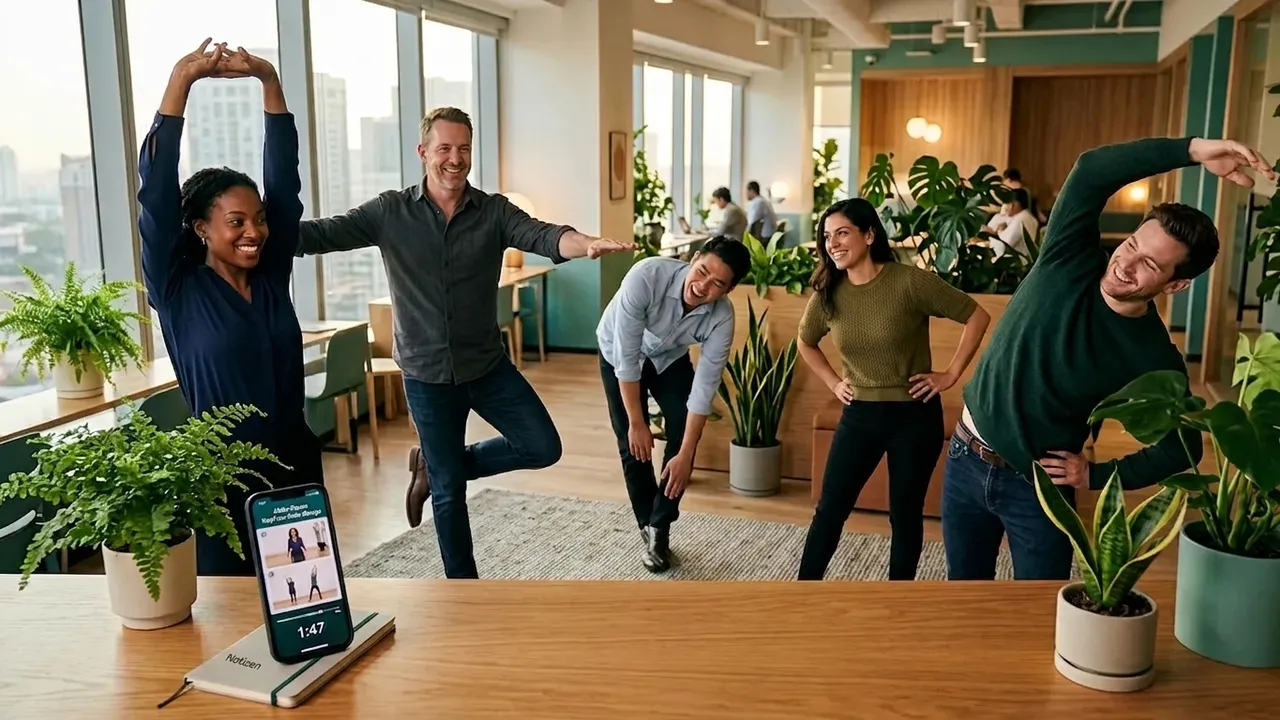
The longest stretches of sitting don't come from laziness but from concentration. Deep in a task, people forget their body, the clock, and their back – until the afternoon slump hits. The micro-break challenge intervenes exactly at this point: it turns standing up into a collective act, removing the hurdle in the process.
Why a short break achieves more than a long walk The nervous system doesn't need an hour of movement to get out of stress mode – it needs interruptions. Just 2–3 minutes of standing, stretching, or breathing is enough to briefly lower cortisol levels and ramp concentration back up afterward. Standing up briefly every hour doesn't cost time – it wins back focus. The challenge gives the effect a name and a framework: four weeks, team ranking, daily check-ins.
How the competition becomes a habit The trick with micro-break challenges is the social mirror: when I see that three colleagues are also marking a break on the hourly tracker, standing up feels normal. After four weeks, the ranking is no longer needed – the body signals it on its own.
How to put it in place
- 1Announce the challenge by email: "21 days, 3 minutes – are you in?"
- 2Share the daily exercise (email, chat, or poster)
- 3Tracking: participants check off each day (downloadable tracking sheet)
- 4Share a weekly interim summary
- 5Day 21: celebrate the result, gather feedback
What you need
- Effort
- under 30 min
- Cost
- Free
- Setup
- 15 min
- ✓ Free
- ✓ Only 3 minutes a day
- ✓ Habit building
- ✓ Doable at the workplace
Adopt it for your company
One click — and the measure sits ready in your plan. Guided step by step, no lengthy setup.
ÜbernehmenZahlt ein auf
Expand physical activity offeringsReduce physical complaints
Measure the impact with
GPAQ – Bewegungsverhalten (WHO)
Handlungsfeld
Physical Activity
Passender Anlass
Passende Best Practices
Nicht sicher, wo ihr anfangen sollt? Selbstcheck →